I have now scanned all of my small Penguin anniversary classic books into the App Book Buddy. I asked it to randomly select a book and it came up with:
Gooseberries by Anton Chekov. It is one of the 80 Little Black Classics. It is only 82 pages long and I finished it in one sitting. This is not the only thing I read this week but it is what I am going to be posting this week. If I have other books or information related to books I will pause and bring you that information. But let’s get on with the Gooseberries. What is it about?
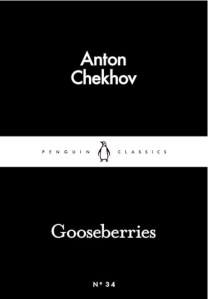
The Penguin and I want to know why anyone would write a book about Gooseberries. I don’t think I’ve ever seen a gooseberry. I certainly haven’t tasted one but now I would like to. I must admit when shopping we tend to buy the same fruits and veg each time. I think I need to pick up something different once in awhile but let’s get on with it. (To Do: Find when gooseberries are in season and buy a couple.)
Gooseberries is one of Anton Chekhov’s most celebrated stories so I imagine some of you have read it already. It was published in 1898. That was four years after my grandparents on my mother’s side were born. I thought you’d find that as interesting as I do. Imagine being alive when Kafka was.
The information provided below has been researched from various reviews and online information and a bit from my own brain. After all we aren’t talking rocket science here. Many people just have better ways of saying things than I do at times..
The story is told by the main character Ivan Ivanich who while sheltering with a friend while on a walk at another friend’s home recounts the story of his younger brother Nikolai Ivanich to the two men.
Here is the story:
Nikolai becomes obsessed with a single dream: owning a small country estate where he can live as a gentleman and grow gooseberries. Imagine being obsessed with a fruit. Especially gooseberries.
To achieve this he lives miserably for years, saves every kopek, marries a wealthy widow for her money and eventually buys an estate.
Ivan decides to visit him and see what the situation is. He is shocked. Nikolai has become pompous, self satisfied, and blind to reality. The estate is shabby, the land poor, and the gooseberries are hard and sour. Yet Nikolai eats them with tears of joy, convinced they are delicious because they symbolise the fulfilment of his lifelong dream.
Watching his brother’s happiness’s Ivan feels deeply disturbed rather than pleased.
So what does it all mean?
- The danger of comfortable illusions
- The selfishness of private happiness
- Moral responsibility. ( I might add he treated his wife terribly and she eventually died having been deprived of anything worthwhile.)
- The gooseberries symbolise dreams fulfilled -but also the way people romanticise what they possess.
- The estate represents the illusion of success and social status.
- The rain at the beginning and end creates a reflective, melancholy atmosphere and reinforces the story’s contemplate mood.
******************
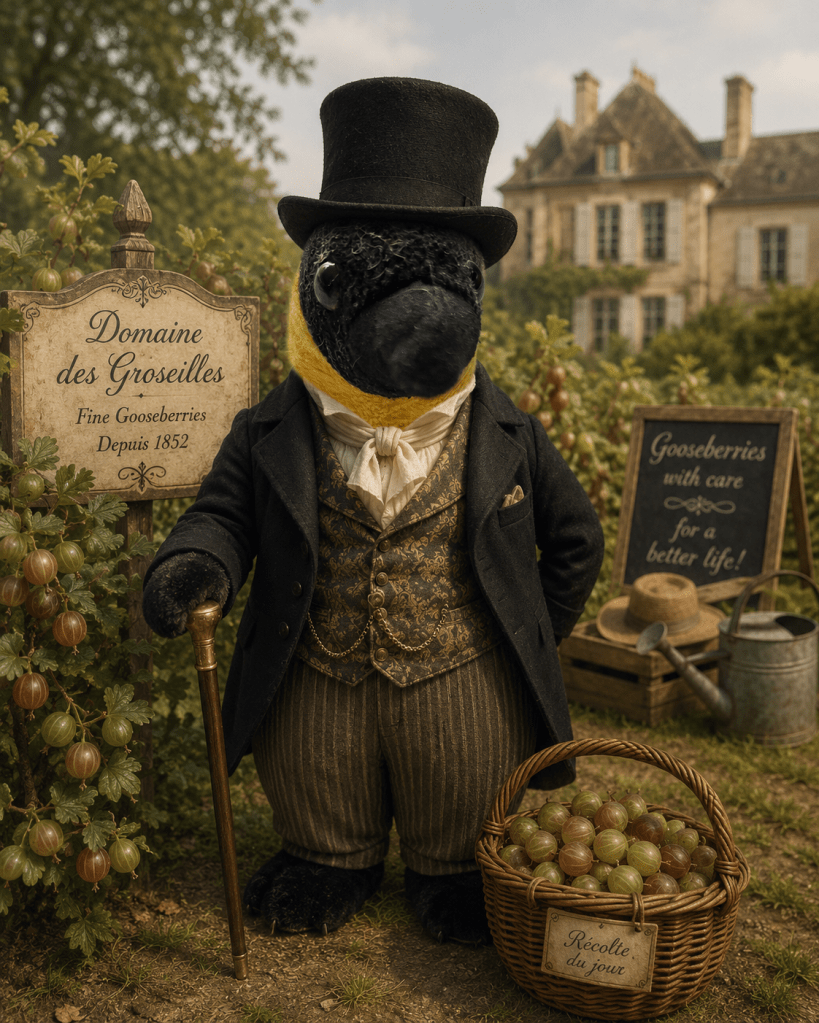
Such a country gentleman.
*************
Favourite quotation from the book0
When Ivan approached his brother’s house, this is what he saw:
“I went up to the house, and was met by a fat red dog that looked like a pig. It wanted to bark, but it was too lazy. The cook, a fat, barefooted woman, came out of the kitchen, and she too looked like a pig, and said that her master was resting after dinner. I went in to see my brother. He was sitting up in bed with a quilt over his legs; he had grown older, fatter, wrinkled, his cheeks, his nose, and his mouth all stuck out- he looked as though he might begin grunting into the quilt at any moment.”
I enjoyed this story. It was a pleasant evening with a cup of tea and a cat and a dog (Pickles and Peanny) on my lap and Ollie quietly snoring in his cozy dog bed nearby as the Tasmanian gale force winds tried to blow our house away.
Now onto regular life.
I did get to a local garden store that has the best plants and trees and spent yesterday digging a hole and planting a beautiful little Japanese maple tree into the yard for my dear friend I lost a little over a week ago. It has been an extremely sad time but planting the tree made me happy and I will always remember her when I look at it. I might add I have two other big plants for two dear friends who passed away in previous years. Along side the bells hanging in our large Japanese maple tree for each pet that we have lost over the last 35 plus years our whole yard is now a peaceful place to be with beautiful memories. All plants in our yard are native except the maple trees and a birch tree. I only plant bushes, etc that attract birds and bees eventually. If they don’t attract them they don’t get to live in my yard. Tasmania seems to have a lot of English gardens with plants that our lovely native birds have not eaten from. Especially roses. Only one very old rose tree lives in our back yard and I only use that to cut a flower or two for the kitchen window.
Today I might get the dogs over to a local beach that is 15 minutes away. Dogs are allowed on Nutgrove Beach in Tasmania during non Daylight Savings Time after 3 pm until the next morning. We’ll see if we get there.
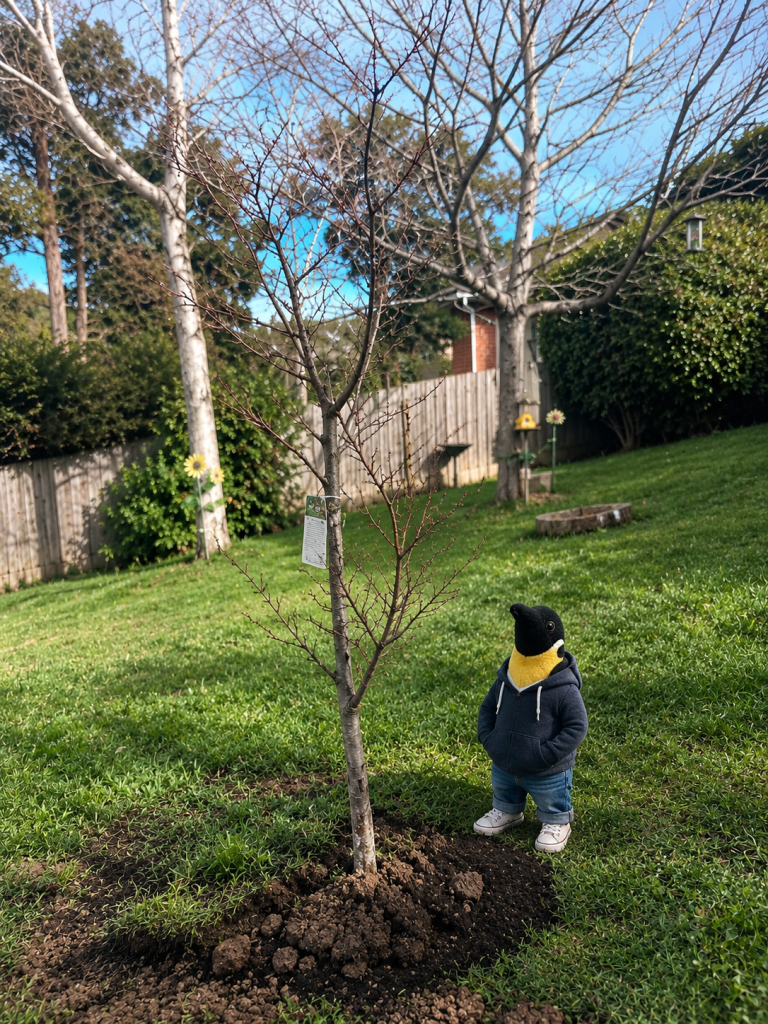
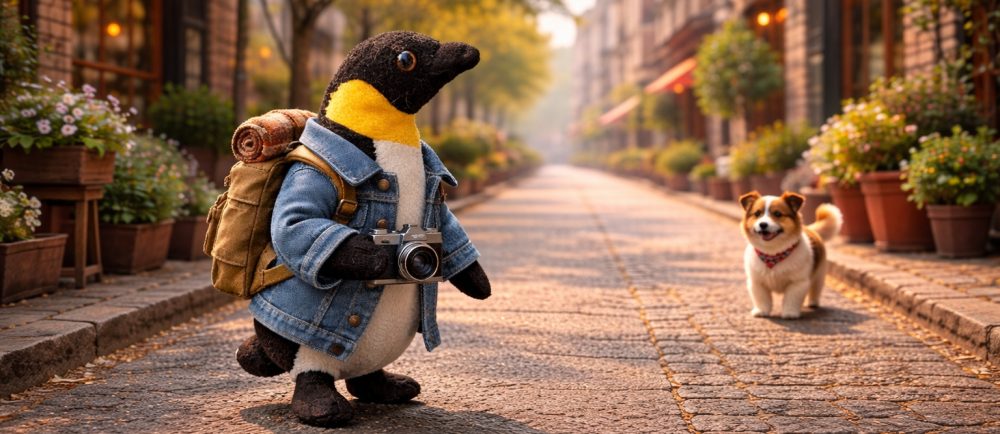
Penguin approves of my friend’s Japanese maple tree. We had fun planting it and I know she would approve. She met the Penguin a couple of times.
Other News
*** I did go to a Fullers book award that other evening with a friend but I will write more about that later. I’m not sure many people would be interested except my Australian bookish friends. So I’ll do a short separate post on it and you can decide if it’s for you or not.
***Mr P is still overseas with family. Gets home the end of this week
*** I have my gym membership on hold so I can spend more time with my animals and my books and my journals. Lots of gentle activities.
****And _ I’ll sprinkle in a couple of photos.
Have a good week.


My Mom made the best gooseberry pie!!!! But she bought them canned. I want to say Oregon Fruit Co. They were really pale in color and I secretly wished she’d put in a drop or two of green food coloring. But ooo it was so good. Very tart. I love that you planted a tree for your friend. I can’t wait to see it all leafed out!Also, Pickles and Peanny on your lap, Ollie snoring, Tasmanian gale force winds trying to blow the house away while you read Chekhov with a cup of tea sounds very cozy. Very cute pictures of Penguin.
LikeLiked by 1 person
I would loved to have tasted your mom;s gooseberry pie. Have you ever made it?
LikeLike
Great post. We used to have gooseberry bushes in the garden when I grew up. You can occationally find them on a market here in Sweden, but they are not easy to come buy. To taste a real mature gooseberry directly from the bush is fantastic.
LikeLiked by 1 person
I might find one to try come summer here. But I agree, any berry picked from a bush is wonderful.
LikeLiked by 1 person
I’m tired tonight, and for the life of me, I can’t seem to understand why you go back and forth between Kafka and Chekhov in your post. The connection escapes me
LikeLiked by 1 person
Haha I don’t know why either. I think I’ve fixed it but now need to change text as Chekov was not French. It’s been a tough week. Thanks for pointing out my error.
LikeLiked by 1 person
Hurrah! Good luck with the project, I’ll look forward to following your progress through the books. As for gooseberries, they were around a lot in my childhood and I never liked them…
And I’m agreement with Lisa about the Saunders books – the stories he includes are great ones, but I hated his commentary on them.
LikeLiked by 1 person
It seems like several people had difficulty with both Saunders and the taste of gooseberries.😀
LikeLiked by 1 person
I have tried gooseberries once, because I kept reading about them, but they didn’t excite me. I should try them again. I do see them occasionally in our local supermarket, probably when in season!!! I don’t take notice because I haven’t been inspired.
In our garden, before we downsized, nearly all our plants were native but not the trees. Canberra is so beautiful for deciduous trees that’s mostly what we had already or planted. Exceptions were a large banksia (which the black cockatoos loved) and a couple of callistemon which birds and insects liked. Bees liked the banksia too of course. Wattle birds seemed to like the Manchurian pears, a favourite of mine. Magpies loved puttering around the ground. They are what I miss the most in our apartment.
LikeLike
One of the reasons I wouldn’t want to move is because I’m so attached to the birds that live in our neighbourhood. One of these days I will try gooseberries.😀
LikeLike
I understand that. Change is really hard. I had so many reasons why I didn’t want to move BUT in the end for other reasons in our lives – primarily the need to be able to go to Melbourne at will not to mention the need to downsize as our family house was too big and too full – I realised the time has come. As is the way with change I think, there have been losses but there have also been gains. Gradually the gains are winning out and the losses become little flutters at times!
LikeLike
I understand about too much stuff in a house. I am slowly removing things from our smaller house. The garage is another matter.
LikeLike
The garage was Mr Gums’ domain and it sure was another matter!!
LikeLiked by 1 person
I haven’t read this story – I must look for it. A lovely idea to plant a tree in memory of your friend. I hope it grows well for you.
No doubt you will be very glad to have Mr P back home with you.
LikeLiked by 1 person
Thank you. Yes I am looking forward to him coming home. A month seems a long time with all that has happened while he’s been away eating and drinking with family. haha
LikeLiked by 1 person
I think I’m going to enjoy your challenge!
Gooseberries… I remember them, and tart gooseberry jam, from my English childhood but I don’t think I’ve ever seen them since. But maybe I just wasn’t looking properly, because we grow practically everything somewhere here in Oz, and the supermarkets stock just about everything whether it’s in season or not. Too bad about food miles, most people don’t seem to care.
Anyway, you are right, this is a very well-known story. You might remember that George Saunders included it in his book A Swim in a Pond in the Rain, which was a collection of classic short stories that he used to teach his students with, and an explanation of why he used each one. I didn’t think much of his book, but I loved the stories in it. (I get huge numbers of hits, BTW, and now you will too (if you’ve tagged it) because students go looking for reviews of it.)
I was disappointed that his aim in teaching seemed not to be teach his students about inequality and excess. I think that teaching creative writing is not just about how, but also why. What is the point of it. If there is not much point to the story, it’s not much of a story.
My jasmine is in bloom!
LikeLiked by 1 person
That’s interesting about the George Saunders book. I’ve not read that book. I hope the Penguin challenge continues to be good. So far so good. One book done, hahaha
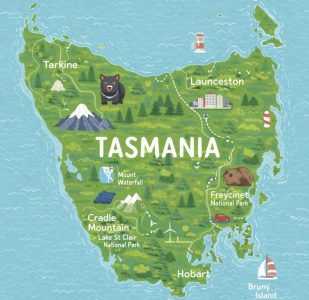
I’ve asked Chat GPT where and when I could find gooseberries in Tasmania. This is what it came up with. How funny.
Because gooseberries are a niche crop, they’re rarely found in supermarkets. Your best chance is:
1. Farmers’ markets in December and January.
2. Local fruit growers in the Huon Valley, Derwent Valley, or northern Tasmania.
3. Growing your own bush—it will usually begin producing fruit within 2–3 years and can remain productive for decades.
Since you’ve been reading Chekhov’s “Gooseberries”, tasting fresh gooseberries is a fun literary experience. Fresh berries are often quite tart when green but become sweeter as they turn yellow-green or reddish, depending on the variety. They’re excellent eaten fresh, or made into gooseberry fool, jam, or a crumble.
Chat GPT made up the mind map I asked for. I have so much fun with it. Evidently the gooseberry season is short, Dec and Jan. i’ll put a note in my diary to look for them then. Lol
LikeLike
I look forward to seeing pictures of a gooseberry bush in your harden before long!
LikeLike