
 Jupiter’s Travels has been on my shelf for a very long time. There are many motorcycle “around the world” travel books out there but this is the bible of all of them.
From Wikipedia:
“Ted Simon (born 1931) is a German-born British journalist noted for circumnavigating the world twice by motorcycle.[1] He was raised in London by a German mother and a Romanian father.
After studying chemical engineering at Imperial College he began his newspaper career in Paris with the Continental Daily Mail. Back in England, whilst undertaking National Service with the RAF he founded Scramble, a magazine for recruits, which caught the attention of Arthur Christiansen, redoubtable editor of the Daily Express, and worked in Fleet Street for ten years. He eventually became Features Editor of the Daily Sketch, and shortly before that paper was amalgamated with the Daily Mail in 1964 he left to found and edit a man’s magazine, King, which survived for three years. He moved to France and contributed to various English newspapers and magazines, including The Observer and Nova.
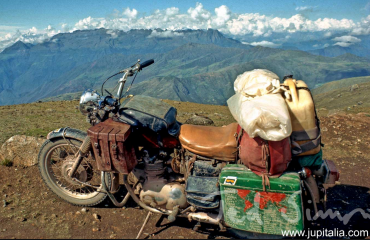 In late 1973, sponsored by The Sunday Times, Simon began travelling around the world on a 500 cc Triumph Tiger 100 motorcycle. For four years he travelled over 64,000 miles (103,000 km) through 45 countries. Most accounts from his trip are detailed in his book, Jupiter’s Travels,[2]while some of the book’s gaps are filled in its second part, the book Riding High.[3]
His books and long distance riding inspired the actors Ewan McGregor and Charley Boorman in their 2004 journey from London to New York on motorcycles (Long Way Round), during which they arranged to meet Simon in Mongolia.”
The Book:
I listened to the audio version of this book as well as reading the hard copy. I enjoyed the narration of this book (Ted Simon and Rupert Degas) very much. He started with the African Continent going from north to south. The roads were rugged, the water crossings were fast and deep and he wasn’t probably as prepared as what Charley Borman and Ewan McGregor were. No support vehicles.
From South Africa he took a transport ship to Brazil and immediately was detained by the police for almost two weeks. The. minds games he had to endure were frustrating to read. He was never arrested but you wouldn’t know it. His bike had all kinds of things go wrong with it but he always managed to fix what it needed and ride on. Sometimes when he ran out of petrol there was none to be had and he had to ride a bus to a small town just to get a litre.
He then rode to Chili, Peru and Colombia. Colombia was very dangerous in the 1970’s but he managed to get through it in one piece. He made it to the Panama Canal and then didn’t write too much more until he hit California having traversed through Mexico.
He was in California, north of San Francisco in a commune for three months where he worked on the land and had a relationship with a woman.
From San Francisco he took another ship to Sydney, Australia. He went north to Port Douglas and then south to Melbourne and west to Perth, across the Nullarbor.
He wanted to go to Indonesia but because Cyclone Tracy had just devastated the city of Darwin there was no transport. The only transport he could get was from Fremantle to Singapore.
From Singapore to Malaysia and then he went to India. Much of the last third of the book talked about India. Once he left India to head back to Europe he didn’t describe as much in his book.
 There are many gaps in this book but as Wikipedia explains above he did a follow up book, filling in those gaps, called Riding High.
Mind you for a 64,000 mile journey over four years, it is hard to limit oneself to 460 pages. There was a lot that was left out.
He philosophises a great deal and at times that felt tedious. It made the overall book quite uneven but it always got back on track. He didn’t describe much of his accommodation but rather focused heavily on the people he met and their lifestyles. It was truly a life changing adventure and I probably don’t do the whole story justice.
I really enjoyed this book. I read a lot of travel writing and this is right up at the top. Every time I got in the car I would listen to more of it. When I woke in the night I would turn it on for the 30 minute sleep timer and listen to more. I was sad when it ended.
 I must mention the narrators of this story did a brilliant job of the African, Portuguese and Spanish accents. When describing the Australians, the accents were amazingly good. I have lived here 30 years now and still can’t pronounce Australian vowels. It was good to hear him read his own book and I am not sure how the two men shared the role because I thought there was only one narrator until I looked at the book’s description on Audible.
 As I started to research more about Ted Simon on google I was pleasantly surprised to see that he did the same journey again 30 years later as a 70 year old man. I have found and ordered the book on Abe Books for $4.00! I don’t think I’ll read Riding High as I have had enough of his first trip. But who knows.
Can’t wait to get Dreaming of Jupiter. He has also recently published another book of his photos. In the 70’s the quality of the photos wasn’t good enough to print but current technology now allows it. The cheapest copy I could find though is $110.00. It is obviously quite collectable. I won’t be looking at that anytime soon.
If you like travel writing then this wonderful writer (I forgot to mention he is a brilliant writer) tells an excellent tale. No google maps, no mobile phones- travel the old fashioned way.





 Excerpt from Australian Dictionary of Biography:
 This last week the card drawn for the Deal Me In Challenge was the Ace of Spades. The story was a very short story called The Hand and it was written by M L Skinner in 1876. It was a simple tale of a few nurses working in a shed of a hospital in Western Australia one night. The night is dark and one of the nurses walks into a room where something seizes her ankle in a firm grip. She has no idea what has hold of her and of course screams. When another runs into the room holding a lantern, which of course gets blown out and needs to be relit, it turns out the ‘grip’ is caused by a hand. A straggler had become lost in the heat, wandered about and in a delirium ended up collapsed in the hospital. The hospital was shaped like the letter L and the back side of it was only under cover, not completely enclosed. The story, in my opinion was very weak and I am still not sure what its meaning was. Perhaps to show the conditions in this building of which they worked? I have no idea. I would be surprised if this was Ms Skinner’s finest work. I must admit though that it did hold my attention in its sparse four pages. Maybe it is more about defining a moment in the late 1800’s in rural Western Australia and I did get a feel for the night. A sort of memoir (if it was a true account which kind of felt like it.)
 Travellin' Penguin