
Posted in 1001 Children's You Must Read Before You Die, Century of Books Challenge, Fiction

The Age of Innocence and Kensuke’s Kingdom

age innocenceI’ve read a couple books this week plus a short story. It’s quite hot out so nice to stay inside where it is cool.  Southern Tasmania is probably the only place in the nation without smoke in the air. It’s really been terrible for people.

I read The Age of Innocence by Edith Wharton for my upcoming book group meeting in February at Fullers Bookshop. Edith Wharton was the first female author to win the Pulitzer Prize in 1921. It was originally serialised in four parts in a magazine the previous year and then published and sold as a book.  I’ll be interested to see what the book group thinks about it. Last year they hated the period piece of Diary of a Provincial Lady by E.M. Delafield which I loved.  I enjoyed this book once I got into it. It’s one of those books I wouldn’t start unless I had a good block of time to get into it so I’d want to pick it up again.

Newland Archer is engaged to May Welland and looking forward to his wedding very

edith wharton
Edith Wharton

much. Then her cousin the Countess Ellen Olenska arrives from Europe where she has left her brutish Polish husband and does not plan to return.  It is the end of the 19th century, New York, so of course there is a great deal of discussion about her upcoming divorce and will she be accepted into society or not.  She is a bit Bohemian, wears scarves, loves the wilder side of life and is very independent.  Newland falls in love with her and that sets up the plot for the rest of the story.

However the beauty of this book is how it defines social class in the later half of the 1800s in New York.  The requirements of proper society ladies and gentlemen are very clear and heaven help you if you break one of them. The scandals, the gossip, the theatre, the interactions between the extended families of both Newland and May come into the tale very much.  It was an important piece of literature in America in the early 1900s because of the impact World War I had on society.  Values were changing and that impacted on New Society and pretty much the entire way of life. Events such as the war, the Stock Market crash of 1929 and the depression changed the face of America. This book defined how life was previous to all of that and you could see the beginning of those changes as the year rolled over into the new century from the 1800’s.  There is also the theme of balancing what is responsible in one’s life versus what one wants. Does one forego a life, hurting many people in exchange for only thinking of oneself to attain what is wanted.  As predictable as the story was the ramifications of how it addressed an important part of American history stays with the reader.  I enjoyed it.

322My second book of the week was randomly selected from 1001 Children’s Books You Should Read Before You Die.  The first couple of selections were not available in our local library but this book was. Michael Morpurgo’s Kensuke’s Kingdom is a book I’d never heard of. Mr. Morpugo was born in 1943 in Hertfordshire, England. He has written many books and our library seems to have most of them. I would think the reading age for this book would be about 9 or 10 upwards. It is the story of an 8 year old boy who moves onto a yacht with his parents after they lose their job when the local factory closes down. They sail to various places in the world and one day while the boy is on watch with his dog, they fall overboard. His parents are asleep below deck and have no idea this has happened. He and the dog manage to stay above water but when all is lost and he becomes unconscious and the dog has floated away, he awakes and finds himself on an island. Only one other person lives on the island, a 90 year old Japanese man who has been there since Nagasaki was destroyed in World War II and he cannot go home again.

The man eventually works out the boy is not an enemy and he takes him under his wing.

Michael_Morpurgo
Michael Morpurgo

They care for the gibbon monkeys and the orangatangs. They live in a cave fitted out with items from a sunken ship nearby. While there, evil men arrive in a sloop with rifles and their aim is to kill the adult gibbon monkeys so they can steal the babies for the tourist trade.  There are a lot of environmental messages in this book. They talk about the animals and the extensive clearing of land. At the end of the book there is a page about all the illegal and governmental land clearance around the world and the impact that has on the wildlife.  The message it portrays is very pointed.  I didn’t think I’d like reading a book for such a young audience but the main characters were enjoyable and developed enough that I cared about them. I worried about the monkeys and orangatangs too. I finished it in a couple of hours as I was interested in how they would all end up.  If I had children in my life I would recommend these adventure stories to them. There is enough adventure that the educational value of it does not become overwhelming.

I’ve got another couple books on the go but I’m not far enough into them yet to say anything.  I have a very funny short story from the book Funny Ha Ha to share too but will do so later.

Until next time…

Yellow Casual Penguin
It’s raining today. We need more!!


This book counts for the Century of Books Challenge:  1920.
Posted in Bit of Fun, Fiction, Short Stories, TBR Challenge

The Secret Life of Walter Mitty

For people who read a lot they will probably know this was an important short story in

Screenshot 3
From Wikipedia

American Literature.  It’s first inception was not a film though two films have been made of this story, neither kept to the plot.

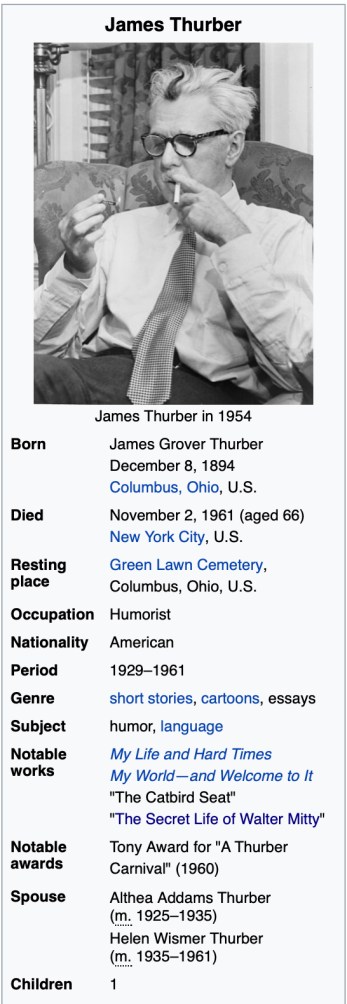
It was written by the wonderful author James Thurber.  I love his tales. I have read him off and on for years and he had such a creative, humorous imagination. He was born in 1894, the same year my maternal grandparents were born though they were a few months older than him. He was a cartoonist, humorist, journalist, playwright, children’s book author and wit. He was best known for short stories and cartoons published in the New Yorker. (Wikipedia).

The Secret Life of Walter Mitty was first published in The New Yorker magazine March 18, 1939. It is a story about a man who day dreamed his life away.  How often do we do that? I was a great day dreamer especially as I sat in school classes and it never really disappeared much into adulthood.

The story begins in Connecticut with Walter driving his wife into the city to do the shopping and have her hair done. Walter doesn’t pay much attention to the real world, but instead lives in a dreamlike state of heroic antics.

As they drive into town his wife tells him to quit driving so quickly. He goes into his imagination and sees himself as a pilot of a US Navy flying boat in a storm. There is a brief description of this episode of heroism. As they drive past a hospital he suddenly turns into a wonderful surgeon performing the trickiest of operations to save the life of his patient.

Screenshot 2Once past the hospital something else catches his imagination and he becomes a deadly assassin testifying in a courtroom. Soon afterwards he is a Royal Air Force pilot volunteering for a secret suicide mission to bomb an ammunition dumb.


Once the trip into town is complete he sees him self standing against a wall facing a firing squad. Each imaginative event is inspired by some detail of his hum drum life.

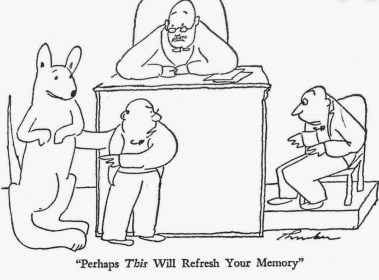
James Thurber’s stories and cartoons often displayed meek mannered men dominated by overweight, domineering wives. It seems to be a joke repeated often over time, especially in cartoons.

I remember the discussions of the story as far back as high school as his short stories, this one as well as The Catbird Seat were often taught in high school English classes. I wonder if they still are. I loved him and his stories. Screenshot 4

This story begins the exploration of the book, Funny Ha Ha, I talked about in a previous post.


Screenshot 1

Posted in A Penguin Post, Memoir, Non Fiction

A Bit of Ruth Park- Australian Writer

ruth park
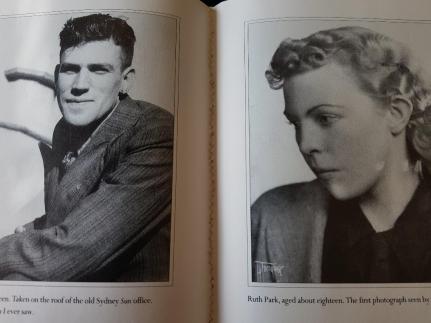
D’Arcy Niland and Ruth Park

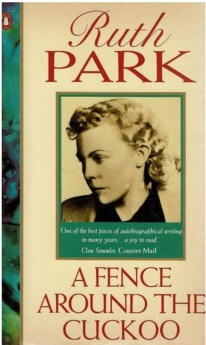
My first book of 2020 is from an Australian female writer of the past, Ruth Park. The book is A Fence Around the Cuckoo, her autobiography of the first 25 years of her life. The remaining years are in a sequel entitled Fishing in the Styx, which I own but have not yet read. Bill Holloway of the AustralianLegend blog is hosting an Australian Women’s Writer week in January (here). I won’t have time to read a lot of the Gen 3 AWWs by mid January but this book qualifies.

Ruth Park was born in New Zealand in 1917 and died in 2010 at the age of 93. Part I of her biography details her first 25 years living in the north island of New Zealand with her large extended family in poverty during the war and depression years. She moved to Sydney in her early 20s where she remained the rest of her life.

She always knew from a very young age she wanted to write. Her parents struggled to ever meet her expectations because of their poverty. Her mother was one of six girls and a couple of brothers raised by Ruth’s grandmother and grandfather. They feature a lot in this story and I enjoyed hearing about their life of squabbles and affection.  Ruth lived with a couple of them from time to time when things got too bad.

Screenshot 2
1992 first published

Ruth didn’t have any access to books at all until she was in her teens. Books weren’t available and neither was paper upon which to write. She talks of one of her uncles bringing home some forms from his office job, that were blank on the back and she thought it was Christmas. She coveted the paper and wrote every chance she got. If the desire to write is genetic she certainly had the gene for it. Her desire was strong.

The book details the type of work her parents and grandparents did, the description of the homes she lived in. Her father had done pretty good until the depression came, he couldn’t work and they lost their home after declaring bankruptcy. The ensuing years were very tough. It wasn’t until WWII when things began to pick up a bit.

I enjoyed hearing about her mother’s seamstress skills and her relationships with her sisters.

Ruth was greatly influenced by one of the nuns where she attended primary school at St. Benedicts.  The nun spent a great deal of time with her perfecting her writing skills, working her harder than the other students as she saw Ruth’s potential. As Ruth approached high school age the Sister helped her get a full scholarship for the rest of her school years.  I felt excited for her at that point, but sadly the family had to move away due to their financial situation and Ruth never got to take it up. I really felt for her.  She was still trying to find books to read without success. Her mother was supportive and wanted her to continue her education but was unable to help her.

Eventually Ruth got a job for the Star newspaper in Auckland, writing in the children’s section. At that time there were sections in newspapers for children of several pages which Ruth loved in her own childhood, if she could get her hands on a paper. During her time at the Star she realises how lowly paid female copy writers were compared to male writers. Most males didn’t believe there was any place for a woman on a newspaper. She was groundbreaking on that front eventually becoming a journalist.

She also met a man from Sydney who worked for newspapers there and they began an uncomfortable pen pal relationship. I say uncomfortable as she thought him a bit arrogant and he was keener to be with her than her with him. Her upbringing was very sheltered and she was also quite an independent child and wanted to remain so because of her own goals in life.

Eventually she moves to Sydney when she is 22 years old as she is offered work on a newspaper there. She learned that women were paid the same as men in copy editing and there were more opportunities.  Her relationship with her pen pal D’Arcy Niland, also a writer, developed more and they married not long after she arrived in Sydney.

I found the book interesting as I saw another side of New Zealand indigenous life, the depression years of the 1930s as well as life during the two world wars. I admired her tenacity and independence in staying focused on her goals throughout her young life. Nothing distracted her mentally. The circumstances ruling her life then were so tough.

As far as autobiographies go I really enjoyed this one. I’d like to read more of her books of which she wrote many during her lifetime.

******************************************

I also began the diaries mentioned in the last post as it’s the first of January.  I opened my own diary and loved seeing all the blank pages waiting to be filled. What will this year be like?

I thought as I read these diaries during the year I’ll add excerpts that I enjoy from different periods of time into some posts.

From A Traveller’s Year: “…in the knowledge that no one pines for me anywhere on earth, that there is no place where I am being missed or expected. To know that is to be free and unencumbered, a nomad in the great desert of life where I shall never be anything but an outsider”  Isabelle Eberhardt, Diary. 1900. 

I’d like to know more of Isabelle’s life. Until next time…..Screenshot 1