
- Author: Sylvain Tesson – French

- Publisher Europa Compass
- Translated from the French by Katherine Gregor 2019
- 177 pages
- Berezina refers to a ‘disastrous situation’
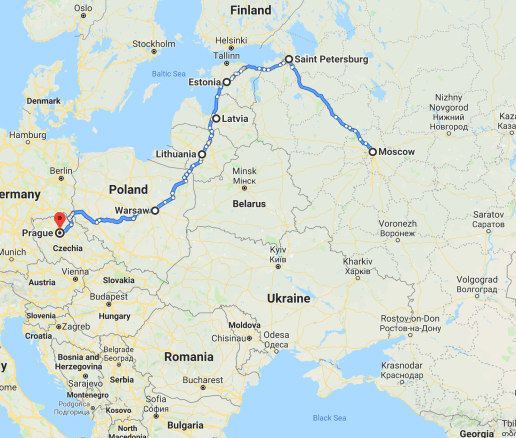
Premise: Four men from Russia and France get three Russian Ural motorcycles and ride from Moscow to Paris in the winter following the retrear of Napoleon from Moscow in 1812.
You’ll need to wear your woolen warmies if you’re reading this book because it is cold. These guys are nuts! First off to have the Ural be the motorcycle transport of choice is crazy.
If you aren’t familiar with a Ural bike, read on:
The Soviets built them in the 1930s, modelling them on the BMWs of the German army. These machines are robotics of the Soviet industry. They promise adventure. You can never tell if they’ll start and once launched, no-one knows if they’ll stop.
They go up to 50 miles per hour. They travel through the countryside devoid of electronic devices. Anybody can repair them with a pair of metal pliers. You. need to get used to driving them, avoid turning right too quickly on pain of lifting the basket and constantly adjust the profile towards the left. For the past twenty years, driven by a blend of fascination and masochism. (Page 35)
Did I mention two of the bikes on the trip had sidecars.

These guys are history buffs and absolutely besotted with the history of Napoleon. The reader learns a great deal about the military retreat of Napoleon when he could not conquer Russia and they in turn, with thousands of troops send him back out of the country. The descriptions of the battles, the deep snow and the stubbornness and insanity of Napoleon at times is quite interesting though I must warn the battles can get quite graphic.
These men wanted to experience the conditions that Napoleon suffered so they are riding across Russia, Lithuania, Belarus, Poland, Germany and France. Most of it in blinding blizzards, deep snow, sub zero temperatures, breaking down constantly, getting drunk on vodka most nights. It is a book I couldn’t put down because I couldn’t believe they were doing this.
I learned more about Napoleon than I needed but it is fascinating history. Two men had to leave during the trip due to other commitments but the other two kept ploughing through. I can’t believe they actually survived the trip. Here are another couple of passages:
“A motorbike helmet is a meditation cell. Trapped inside, ideas circulate better than in the open air. (I can confirm this.) It would be ideal to be able to smoke in there. Sadly, the lack of space in an integral crash helmet prevents one from drawing on a Havana cigar, and the ensuing wind blows out the burning tip when the helmet is open. A helmet is also a sounding box. It’s nice to sing inside it It’s like being in a recording studio. I hummed the epigraph from Céline’s Journey to the End of the Night. These lines were to become my mantra for weeks to come. (page 58)”
Our life is a journey. Through Winter and Night, We try to find our way, Beneath a sky without light.
They often referred to “a top location”. You might wonder what that means. Here is their definition.
” Is a stretch of geography fertilised by the tears of History, a piece of territory made sacred by an act, cursed by a tragedy, a land that, over the centuries, keeps echoing with hushed-up suffering or past glory. It’s a landscape blessed by tears and blood. You stand before it and suddenly sense a presence, a surge, a manifestation of something you can’t quite put your finger on. It’s the echo of History, the fossilised radiation of an event that seeps out of the soil like a wave. Tragedy has been so intense here, and in such a short space of time, that the geography hasn’t recovered yet. The trees may have grown but the Earth continues to sugar. When it drinks too much blood it becomes a to location. Then you must look at it in silence because it’s haunted by ghosts. (page 107).
And last but not least is a short insight into Napoleon.
” Napoleon had always felt the need to strive towards an idea. Did he not profess that the world was led by imagination? He would project on the screen of the future the images of his mental constructions. Nothing must hinder the mechanics, a defeat was not conceivable. This is why the Emperor gives the impression of brushing aside the Russian disaster, minimising it, and casting it out of his mind. Sadly, the means at his disposal were never sufficient to brig his plans to a successful conclusion, and to consolidate the work he had begun in every direction and every country. He started everything and finished nothing. He wanted to redesign the world, but didn’t achieve a single local reform.
And so his reign was like the sleigh trip: a crazy pursuit. (Page 156)”
In finishing I’d like to say the Penguin suggested I rehome this book so if you’d like a copy of it email me or leave in the comments you’d like it. If more than one I’ll use the random generator. It’s a relatively small book so happy to mail it anywhere in the world.

About the author: Sylvain Tesson has traveled the world by bicycle, train, horse, motorcycle and on foot. His best selling accounts of his travels have won numerous prices, including the Dolman Best Travel Book Award for the Consolations of the Forest: Alone in a Cabin on the Siberian Taiga (2013)

 Writing Across the Landscape 1960 to 2010 edited by Giada Diano and Matthew Gleeson. This is one of the stories of Lawrence Ferlinghetti, now 100 years old, who has been many things: (from the blurb on the back) a poet, painter, pacifist, publisher, courageous defender of free speech and the co-founder of San Francisco’s legendary City Lights bookstore. (A store I absolutely adore.) This is a compilation of his travel journals spanning 60 years of various places around the world. It’s a chunkster so won’t be travelling with it but the bits I’ve dipped into are fascinating.



 Last night a friend and I went to the Playhouse Theatre in Hobart. It is the home of the Hobart Repertory Theatre Society that was established in 1926. They feature amateur community productions. One often sees the same actors from play to play. The plays can be excellent and there is a very congenial attitude of mixed ages in the audience. Also chocolate is very cheap. You get a chocolate bar, a glass of wine if you wish, take it to your seat and enjoy the play. I support them every year by going to most of their performances. Last night we saw a production of Treasure Island by Robert Louis Stevenson. It was a cold and windy night and the audience wasn’t packed like it usually is but the people who bothered to come out had a good time. They didn’t seem to have enough men/boys for the pirates so many girls played both girls and boys. They made good pirates. A young woman played the part of 14 year old Jim Hawkins and she did such a good job. Long John Silver was great fun. (Can’t find actor’s name). It was a nice way to spend a couple of hours on a Saturday night despite the cold.
 I finished the Mongolian horse race book by Lara Prior-Palmer, Rough Magic. I found it to be an average read. I liked her writing and hearing about the logistics of the horse race. She wrote about some of the Mongolian people she met and that was interesting. I got a little bit tired in parts when she flashes back to other times in her life. I think she had a lot of time to think of her past as the traversed the long days on the Mongolian steppes. I know when I rode my Scooter from Hobart to Long Reach, Queensland in Australia (one way 2300 kms/1450 miles) I was on very long straight stretches of road and your mind wanders to all sorts of memories, thoughts, creative ideas, future plans. She put a lot of these thoughts into her book. I would give it three stars. Just a good read. However I do think she is a character whom I will remember for a long time and I will remember her story. That is always a good measure of a book.
 Good Reads describes it as: A gripping and shocking story of a serial killer mother, and the brave daughter who brought her to justice. Dulcie Bodsworth was the unlikeliest serial killer. She was loved everywhere she went, and the townsfolk of Wilcannia, which she called home in the late 1950s, thought of her as kind and caring. The officers at the local police station found Dulcie witty and charming, and looked forward to the scones and cakes she generously baked and delivered for their morning tea.



 Travellin' Penguin