I live a retired life in Tasmania, Australia. I love books, travel, animals, photography, motor biking and good friends. I indulge in all these activities with the little Travellin' Penguin who has now shared five continents with me. We love book shops, photography walks and time with friends as all our family is in USA and Canada. I enjoy visitors to my blog so hope you'll stop by.
Glenyse Ward was born in 1949. She was removed by the Australian government from her parents as an infant and put into the St Joseph Orphanage in Perth, Western Australia. Once she turned two years of age she was transported to the Wandering Mission (St Xavier Native Mission), a Catholic missionary and raised by very strict, controlling German nuns.
She lived there until age 14 when she went to the Bigelow family to work as a domestic slave. Mrs. Bigelow was the wife of the Lord Mayor of the town and always referred to Glenyse as her slave and worked her as a slave. She was made to eat and drink out of the tin dishes reserved for the cat and she slept in a tiny attic room above the garage. She showered in the same area Mrs. Bigelow washed the dogs.
Growing up in the orphanage she had her friends who she continued to miss the rest of her life. Two of the friends turned out to be her biological sisters. That surprised her greatly. She was told her father had died in an accident and remain surprised as she already believed he was dead. She had knowledge of where her mother lived but wasn’t allowed to see her. Her mother visited her once at the missionary but the nuns turned her away because she was apparently very drunk.
This book is her story working for the Bigelow family. They lived in wealth in a beautiful farmhouse. Mrs Bigelow would not acknowledge Glenyse’s name or speak to her.
Life at the mission was hard as all the children were expected to work hard at their
The author Glenyse Ward now.
chores and study their lessons. When she approached her teen years a new teacher arrived, a man who separated the girls by colour. He would teach the lighter skinned girls as he believed they had the ability to learn but the darker skinned girls weren’t believed to be capable of learning.
This is a very slim book of her domestic years, 157 pages long. I picked it up in a second hand bookshop and will pass it on. If anyone in Australia would like this book I’m happy to post it to you. Let me know in an email at psbparks at ymail. dot com.
The story is very appropriate for young adults also and I think the reality of her life was crueler than what she wrote about in this book. That’s why I wondered if it was written for a younger audience.
There is a lot more information about the author here and here if you’re interested.
You can hear her testifying about her experience related to the Stolen Generation here.
I would be interested in reading more about this woman’s life as an adult. The book described here takes her through her teenage years.
This week has been very windy and rainy. Every time the sun comes out and I think I can take our puppy, Ollie out it begins to rain again. I’ve learned he isn’t crazy about the rain/wind combination. A little soul who takes after me.
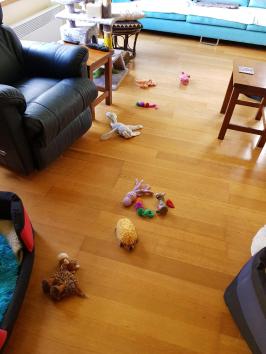
Our games are confined to the house and there have been several very funny high speed runs throughout the place, much to the amusement and sometimes dismay of three cats.
The other evening I went into town to Fuller’s Book shop to attend the launch of Archie Roach’s new book, Tell Me Why: The Story of My Life and Music. Archie Roach is an Aboriginal musician, in his mid 60’s who has had great success in his music career but when you read his book you wonder how it is this man is still alive. He was part of the Stolen Generation, being taken from his home by the government when he was two years old along with his sisters and brother. He never saw his parents again. He was put into an orphanage with his older sisters and then adopted by an older, Pentecostal, Scottish couple who he loved and was treated kindly by. There had another Aboriginal child they raised who ran away in his teens and never heard of again. There is a time period before this adoption where he was in foster care and treated very badly. He doesn’t talk or write about this experience. He only says he was treated very cruelly. However when he was 16 yrs of age he learned he had biological family when his oldest sister sent him a letter at his school. It triggered forgotten memories and created a great deal of confusion in his mind.
From there on the story becomes familiar. He goes off the rails, leaving his comfortable home, becoming homeless as he tries to discover who he is, who is family is and how he ended up where he is and why it happened. He went to Sydney and accidentally met a woman in a pub that turned out to be his biological sister. From there he went to Melbourne and found other Aboriginal people who knew of his family. The book is his story.
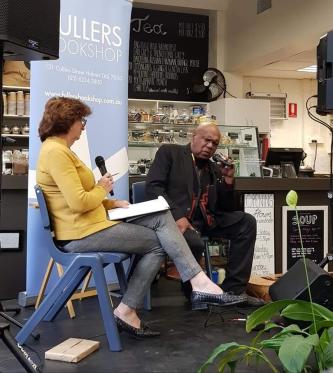
When he arrived at Fuller’s book store the other evening he was in a wheel chair as his health has certainly suffered from his alcoholic past, the number of years he smoked both cigarettes and weed, his life living rough. He now has several respiratory ailments and as he was wheeled into the book store he had his agent with him and a friend, Rosie Smith, who is also a writer of poetry and she facilitated the conversation with us. He was helped into his seat and looked out at the packed bookstore. I was in the second row having arrived early to get a seat.
He is softly spoken and began telling us stories, several of which are in the book. He seemed tired but his smile came out during the telling of some of these stories and everyone in the audience sat spellbound. You could hear a pin drop.
He told us stories for about 35 minutes and then he tired. He was wheeled into the back of the shop where he used the facilities, then came out again and was seated before us. He asked if we wanted more stories and Peter, the staff member at Fuller’s said we could listen to him for days but he could tell he was tiring. Archie pulled out his guitar and sang the first song he ever wrote to us. The book describes how the songs he wrote came to be created. We would have loved to hear more but we all could see he was fading a bit.
There weren’t going to be anymore songs and we all respected that.
He couldn’t sign books either due to his poor health but there was a woman on the tour who had a stamp and ink impression of a wedge tailed eagle. Each book purchased had the wedge tailed eagle stamped onto the title page of the book. Archie explained the wedge tailed eagle had been his mother’s dreaming animal and it would be with him always. His father had the dreaming animal of the red bellied snake. He told us the snake is in his veins, the eagle is in his heart.
I purchased the book and had finished it within 48 hours. I couldn’t put it down and as the weather agreed with staying indoors and reading so I took full advantage of it.
The book is well written and we learn of the lives of all of his family members. He speaks at length about his beloved wife Ruby who was truly a soul mate and a writer, poet, singer in her own right. They travelled the world together singing and writing songs together.
I’m not a big music follower and admit I knew who Archie Roach is but haven’t listened to his music extensively. Each chapter begins with the written lyrics to a song, then the story behind it is revealed.
When I finished the book, I sat silently and thought, “Wow, what a tale.” I will never understand as long as I live why the Australian government thought it a good idea to remove the children of Aboriginal and Torres Strait Islanders and put them into orphanages, missionaries, run by the churches to be assimilated into white families. The ongoing tragedies of this decision continues to be ongoing and those affected by it were lucky in many cases to survive the experience. Most of Archie’s relatives are gone now and there is a visible sadness that lives in him still. It can never be erased and he has learned to live with it, and continues to be successful. I loved everything about this book and although I know the story of many events around the Stolen Generation and how Aboriginals have been and continue to be treated in this country this book makes it very personal. I can’t recommend it enough, especially to people who aren’t familiar with the government policies that happened in this country for several decades.
14 week old Ollie after a day of chasing bubbles in the yard and attending Puppy Play School.
The past three months or so have been so incredibly busy I have called a complete strike from now until the new year. I’m calling a halt to all events that aren’t absolutely necessary. We are enjoying spending time with Little Ollie and I want to devote the upcoming summer months to training him.
As he has afternoon naps each day, I have been able to get some reading in. The first book I have just finished is the wonderful story The Cherry Picker’s Daughter. This memoir begins in her childhood and goes up until her later life. She writes of her family history that is tragic and her childhood growing up with such a large extended family. The story waivers between tragedy and joy and it is a tribute to Mummy, the older sister of her father who is incarcerated for killing her mother when she was only three months old. This is her family’s story and she was adamant it would be told. The day after she was satisfied the manuscript of this book was finally ready for publication she passed away.
From the back cover of the book:
“This is the story of Kerry Reed-Gilbert, daughter of Kevin Gilbert, famous Aboriginal activist, writer, painter and actor. Told in the child’s voice and in the vernacular of her Mob, she speaks of love and loss, of dispossession and repeated dislocation. Kerry’s account highlights the impact of life as an Aboriginal state ward living under the terror of the Protection Laws. Despite this, she paints a picture of hard work and determination, with family unity giving them the strength and dignity to continue.
Her father’s sister; whom she always called ‘Mummy’ raised his two children along with hers and others within the extended family. The book is a tribute to this truly remarkable woman; their tower of strength, love and selflessness.
A tribute to the late Kerry Reed-Gilbert given by Melissa Lucashenko at the launch of Aunt Kerry’s memoir, The Cherry Picker’s Daughter at the Avid Reader Bookshop in Brisbane on 16b September, 2019 can be read here for much better information than I could give this wonderful woman justice.(read here)
I am going to the launch of this book at Fuller’s Bookshop in Hobart tomorrow evening by Jim Everett-puralia meenamatta. I am really looking forward to it.
I could never do this book credit by trying to review it so I will leave you with what is here and the link to her memorial. I will say I couldn’t put it down. It’s a grim yet uplifting history of this Aboriginal family and yet again it is one of many stories that people need to be told. I hope it is widely read.


 Wandering Girl by Glenyse Ward 1987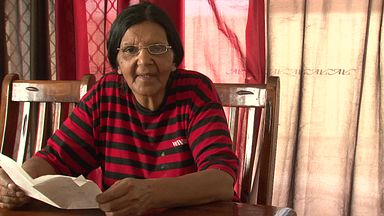

 He is softly spoken and began telling us stories, several of which are in the book. He seemed tired but his smile came out during the telling of some of these stories and everyone in the audience sat spellbound. You could hear a pin drop.
 When I finished the book, I sat silently and thought, “Wow, what a tale.” I will never understand as long as I live why the Australian government thought it a good idea to remove the children of Aboriginal and Torres Strait Islanders and put them into orphanages, missionaries, run by the churches to be assimilated into white families. The ongoing tragedies of this decision continues to be ongoing and those affected by it were lucky in many cases to survive the experience. Most of Archie’s relatives are gone now and there is a visible sadness that lives in him still. It can never be erased and he has learned to live with it, and continues to be successful. I loved everything about this book and although I know the story of many events around the Stolen Generation and how Aboriginals have been and continue to be treated in this country this book makes it very personal. I can’t recommend it enough, especially to people who aren’t familiar with the government policies that happened in this country for several decades.

 A tribute to the late Kerry Reed-Gilbert given by Melissa Lucashenko at the launch of Aunt Kerry’s memoir, The Cherry Picker’s Daughter at the Avid Reader Bookshop in Brisbane on 16b September, 2019 can be read here for much better information than I could give this wonderful woman justice.
 people need to be told. I hope it is widely read.
 Travellin' Penguin