I live a retired life in Tasmania, Australia. I love books, travel, animals, photography, motor biking and good friends. I indulge in all these activities with the little Travellin' Penguin who has now shared five continents with me. We love book shops, photography walks and time with friends as all our family is in USA and Canada. I enjoy visitors to my blog so hope you'll stop by.
Last week I woke up to a beautiful, sunny day in Hobart. Ollie needed to get out as he is a live battery on wheels and had a full charge in him. He’d had a bath the day before, he was fluffy and raring to go.
Hobart has a lot of parks and reserves and though we often go to the dog beach today I decided on a 3 km bush walk. It wasn’t that long but there are hills in Hobart and they are everywhere. So Ollie was put into harness and off we went to the Knocklofty Reserve. This reserve is high on a hill and overlooks Hobart. It is very much a bush reserve with many birds. I could hear many of them but they were high in the trees and wouldn’t come down and pose for my photos.
String bark Eucalyptus trees. When fires hit these trees the strings burn, saving the rest of the tree from the flames. Very hardy trees. Nature is so clever.
There were a lot of people out walking, picnicking playing with their dogs. We came upon a woman walking five Lhasa Apsos. There are areas of water that have been set up for the frogs. We walked around the frog ponds and I heard a few but being winter there wasn’t much activity.
The view towards Hobart through the bush.
Ollie is working well as a photography dog. I drop his leash, say “Wait!” and he stands still. All the beans in this little guy stop moving and I can get the photo without my arm being pulled out of its socket.
Enjoy the photos and hope you enjoy Hobart that you visit one day. You will get a personalised tour if you do. It will include beautiful scenery and lots of cafes or pubs.
I love the texture in this tree. You can see the casino down on the river by the yacht club. Where the fancy people live. 😁😁
An overview of Hobart. It was built around the River Derwent and the city centre is off the left out of view.
Ollie turned one year two weeks ago. We celebrated his birthday with new rubber pigs.
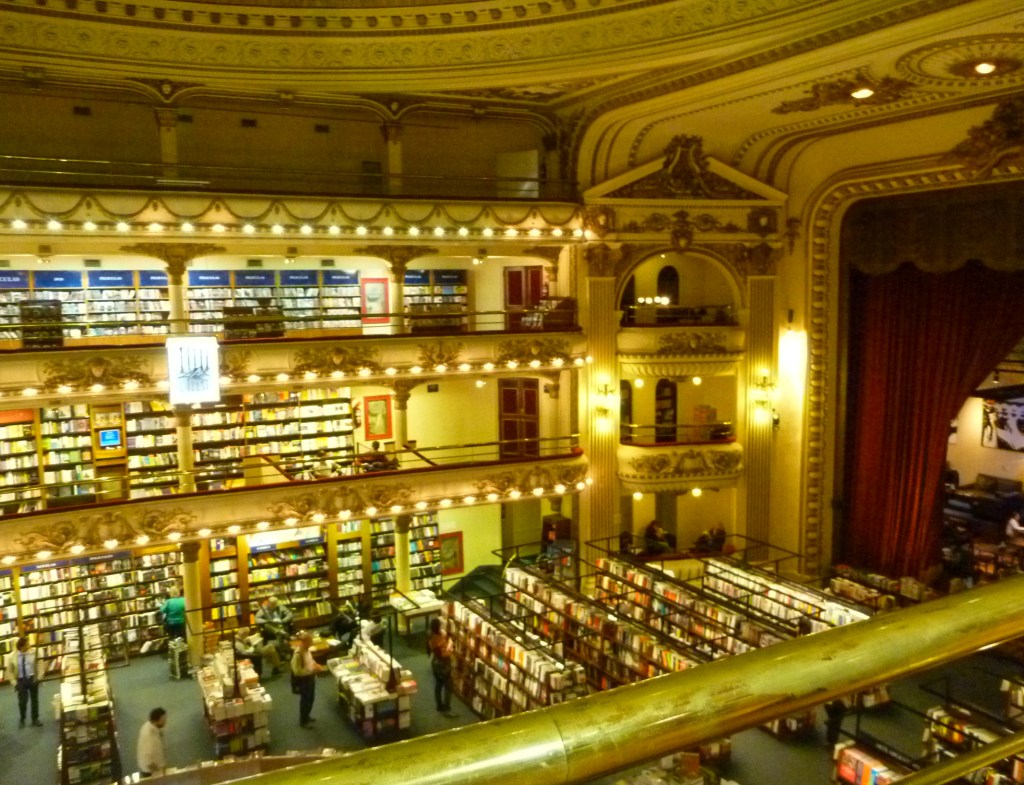
Today I hope you have a cup of tea or coffee. Sit down, put your feet up and enjoy the El Ateneo Grand Splendid Bookshop in Buenos Aires, Argentina. We visited their in 2012 so I am reaching back travel wise. The Guardian has rated this bookshop the second most beautiful bookshop in the world. National Geographic rated it as the most beautiful. (Wikipedia)
It was certainly the most beautiful bookshop I’ve ever been in.
“Situated on Santa Fe Avenue in Barrio Norte, the building was designed by architects Peró and Torres Armengol for impresario Max Glücksmann (1875-1946), and opened as a theatre called Teatro Gran Splendid in May 1919. The building features ceiling frescoes painted by the Italian artist Nazareno Orlandi and caryatids sculpted by Troiano Troiani, whose work also graces the cornice along the Palacio de la Legislatura de la Ciudad de Buenos Aires.
The theatre had a seating capacity of 1,050, and staged a variety of performances, including appearances by the tango artists Carlos Gardel, Francisco Canaro, Roberto Firpo and Ignacio Corsini. Glücksmann started his own radio station in 1924 (Radio Splendid), which broadcast from the building where his recording company, Nacional Odeón, made some of the early recordings of the great tango singers of the day. In the late twenties the theatre was converted into a cinema, and in 1929 showed the first sound films presented in Argentina.” The architect Fernando Manzone transformed it into the stunning bookstore in 2000.
Okay, enough history. I have photos to share with you and I hope you enjoy them. (Mind you the photos were taken before I began photography courses so bear with me. Lumix point and shoot tiny camera. But you get the gist!
Art work on the ceiling.
Need I say anything??
There were quite a few specialty areas.
The children’s section has a very good selection and I enjoyed seeing the illustrations of the Spanish books.
The cafe was up on the stage and the food, as you can see, was beautiful.
There was one problem with this shop for us. Almost every book is in Spanish. I think that was a good thing in the end as I didn’t buy anything except maybe a notebook or some cards. I don’t remember.
I downloaded an audible book this week and went through it fairly quickly as it isn’t overly long but what a sobering story it is.
Life can be beautiful if you make it beautiful. It is up to you.
From Booktopia:
“Eddie Jaku always considered himself a German first, a Jew second. He was proud of his country. But all of that changed in November 1938, when he was beaten, arrested and taken to a concentration camp.
Over the next seven years, Eddie faced unimaginable horrors every day, first in Buchenwald, then in Auschwitz, then on a Nazi death march. He lost family, friends, his country.
Because he survived, Eddie made the vow to smile every day. He pays tribute to those who were lost by telling his story, sharing his wisdom and living his best possible life. He now believes he is the ‘happiest man on earth’.
Published as Eddie turns 100, this is a powerful, heartbreaking and ultimately hopeful memoir of how happiness can be found even in the darkest of times.
About the Author
Eddie Jaku OAM, was born Abraham Jakubowicz in Germany in 1920. In World War 2, Eddie was imprisoned in Buchenwald and Auschwitz concentration camps. In 1945, he was sent on a ‘death march’ but escaped. Finally, he was rescued by Allied soldiers. In 1950 he moved with family to Australia where he has lived since. Eddie has volunteered at the Sydney Jewish Museum since its inception in 1992. Edie has been married to Flore for 74 years. They have two sons, grandchildren and great grandchildren. In 2020 Eddie celebrates his 100th birthday.”
**************************
This was a story I had to grit my teeth before I started it. I really hate reading about the holocaust but I know how important it is for people to learn as much as they can about. it. Also it is this man’s life goal to tell people his story. He was captured in 1938 and endured the most incredibly, mind bending horrors I have ever read. Yet he survived. Not only has he survived but he is now turning 100 years old and he continually tells people his story.
With what is currently happening in this world the time could never be better than it is now. It will always be a relevant tale I am sure.
I won’t describe it anymore than I have because I can’t do his story justice. I will say it is a story filled with hope. It is important. The author is a truly remarkable man and what can be learned from this book is that attitude is incredibly important. It puts everything people are going through now into perspective. This will most likely be my most important reads of the year. I hope others bite the bullet and read it
Having visited Auschwitz I had those images in my mind. It was such an important place to visit and reflect upon and shouldn’t be considered simply a tourist destination.