

 Just wrapping up a bit of odds and ends reading this past week. I had to catch up on my Deal Me In Challenge short stories. I skipped a couple of weeks, then read three in one week.
Two of the stories were from the book That Glimpse of Truth: 100 of the Finest Short Stories Ever Written published 2014
The Ace and Five of Hearts:
One was the very easy Aesop’s Fable of the Hare and the Tortoise. I don’t think I need to say much about that as that is a story most of us learn by heart at a very early age. I do still love it though. That turtle just plods on and on and always gets there in the end.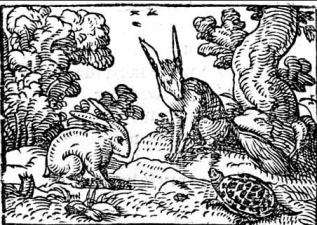
The second story I read is by Joseph Conrad called The Lagoon. I have noticed many readers haven’t cared for Joseph Conrad’s novels that much. I have never read one. I did read online that some think his short stories are better than his novels. I enjoyed this short story. It held my interest and I found it to be moving and well written.
*The narrator is Arsat He tells of the time when he and his brother kidnapped Diamelen (his lover, who was previously a servant of the Rajah’s wife). They all fled in a boat at night and travelled until they were exhausted. They stopped on a bit of land jutting out into the water to rest. Soon however, they spotted a large boat of the Rajah’s men coming to find them. Arsat’s brother told Diamelen and Arsat to flee to the other side, where there was a fisherman’s hut. He instructed them to take the fisherman’s boat and then stayed back, telling them to wait for him while he dealt with the pursuers. However, Arsat did everything but wait for his brother. As he pushed the boat from shore, he saw his brother running down the path, being chased by the pursuers. Arsat’s brother tripped and the enemy was upon him. His brother called out to him three times, but Arsat never looked back; he had betrayed his brother for the woman he loved. Towards the end of the story, symbolically, the sun rises and Diamelen dies. Arsat has nothing now; not a brother nor a wife. He has lost everything. He plans to return to his home village to avenge his brother’s death. The story concludes with “Tuan”‘s simply leaving, and Arsat’s staring dejectedly into the sun. (*source Wikipedia)
The third story is from the book Australian Short Stories. These stories are very old, early 1900’s and I enjoyed the one selected. Ernestine Hill’s The End of an Idol (From the A.B.C. Weekly- early 1900’s). She was an Australian journalist, travel writer and novelist born 1899. She died in 1972. I hadn’t heard of her but I did find a bit about her online. She lived on a large property in Queensland and the story is a memoir about a drifter who came onto the property looking for work. He arrived with donkeys in tow and asked for a job as a cook, which they badly needed at the station. It turned out he had been a circus performer in his past and he entertained everyone on the property and ended up becoming much loved by the owners, workers and indigenous workers alike. The children adored him. However he becomes sick and needs medical attention and has to take his donkeys to travel to the hospital which is three days away. The journey is long, he becomes tired, he lies down and passes away at the very end, never making it to hospital. It is well written and touching tale that I enjoyed very much.

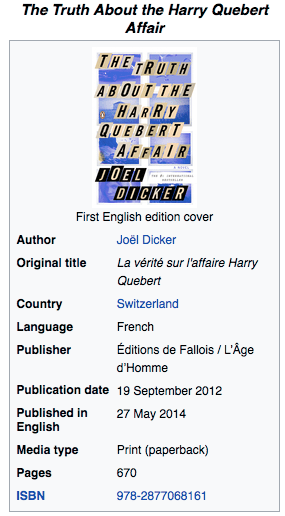
The novel I am listening to and almost finished with is The Truth about the Harry Quebert Affair I am listening to the audible version narrated by Pierce Cravens (excellent narration) and written by Joel Dicker. Joel Dicker is a Swiss writer and this book was published in North America in English in 2014. I listen to it when in the car and when trying to sleep at night or during the night if I wake up and can’t get back to sleep.
Evidently the book was more popular in Europe than in the USA. The Americans thought it was lacklustre and full of cliches (which I agree with.) This book makes me laugh. The dialogue is so bad you just can’t believe it. The book is more than 600 pages. The story is interesting in that it is a book within a book. The story does keep my interest though it is exceedingly repetitive. Some of the structures within it are great fun. In brief, it is a story of a New England American writer and lecturer in his 30’s who falls for a 15 year old girl in a small town in New Hampshire. Their love relationship becomes monumental but it is unconsummated because she is under age. They make plans to run away to Canada and marry when she is old enough. However she goes missing and her body is found 35 years later buried on the perimeter of his property. Harry had a student, Marcus Goldman, who idolised him and is himself a writer. He decides to write Harry’s story after Harry is arrested for her murder once her body is found.
 There are twists and turns and just when you think you have it all figured out it changes again. But the book is so badly written at times that laughter is the only way out of it. I read several reviews on Good Reads and people either absolutely hated it or love it to pieces. It is not great literature by any means. I think if I were reading the hard copy I would have quit by now but the audible has the voices of all the town’s people and I like following them. I am having fun with it (for the most part).
Also…….It is a bit of fluffy distraction as we prepare for next week.
What is next week you might add?
Packing is the first clue. The second clue is getting the house sitter organised and the cats sent off to camp (cattery).
We are off on a 25 day trip with 10 other people to Botswana, Namibia and the Zimbabwe side of Victoria Falls. So the next post might be delayed a bit but the Penguin is packed and you will see him in the next posts. He is getting ready to be photographed on the 5th continent of his life. I know. It is exciting and there are adventures to be had during the month of March. I will try to post up somethings as we go but not sure what internet availability will be so bear with us.
So the “Travellin’ Penguin” is on the move again and “Yes”, I am taking reading material and I’m sure there will things to read, see and talk about along the way. Stay tuned.



 As one of the most respected small publishing houses in Australia, Magabala Books works to celebrate the talent and diversity of Aboriginal and Torres Strait Islander voices through the publication of quality literature. Magabala Books has released more than two hundred titles from a range of genres.
 I thought I’d have a poke around our State Library to see what indigenous publishers they stocked on their shelves. I have been slowly exploring them. This came up first off and as I checked it out I saw some beautiful children’s books. I noticed that one of them, Mad Magpie, written and illustrated by Gregg Dreise, won the 2017 Speech Pathology Australia Book of the Year in the Indigenous Children’s category. That is an association that was very dear to my heart years ago when I was working and I sat on their national committee as Vice President Finance for several years in the 1990’s. I remember when the book awards were established by the association but later forgot about those awards in my retirement years and was happily surprised to see it again. I had to check it out and see what it is about.
 Mad Magpie is a story about dealing with bullies.
 The book is beautifully illustrated with Indigenous art and I am sharing a few pages with you. Gregg Dreise has written and illustrated other books for children and I see that Silly Birds won this same award in 2015. I have placed two more of his books on my wishlist at the library and will look at them after I return from my March travels. I enjoy the stories of the Dreamtime as they explain the Indigenous versions of nature. They are beautiful tales.
 I will continue to explore this publishing establishment as they have a range of books for children through to adults. Our library seems to have quite a few of their books.

 Travellin' Penguin